
June 2022 Update
On Saturday, March 26, 2022, the OCA Evidence-Based Framework Advisory Council (EBFAC) held its final meeting and discussed important next steps, including publication preparation for research papers. Advisory council members dedicated almost a full day to lead an engaging and productive session that provided a solid foundation for the future of the work done to date.
“Over the course of our work for the past two years, one of the biggest shifts for me in my understanding of evidence-based chiropractic care has been the importance of clinical expertise,” says Dr. Deborah Kopansky-Giles, professor at the Canadian Memorial Chiropractic College (CMCC) and staff chiropractor at Unity Health Toronto. “It’s a concept that’s truly interwoven in and underpins all areas of evidence-based care. Clinical expertise grows over time with practice experience, with ongoing professional development and in learning from patients. One should value and not underestimate the importance of one’s clinical expertise in helping people manage their health to the best of their abilities.”
The OCA EBFAC, comprised of 13 members and one patient member, launched its work on January 18, 2020. For the past two years, they’ve been working toward realizing the council’s overarching goal of developing a comprehensive understanding and inclusive definition of chiropractic care.
“If you ask any health care professional or patient in Ontario to define evidence-based chiropractic care, you’ll likely hear a range of answers,” says Caroline Brereton, CEO, OCA. “This is why we formed the Evidence-Based Framework Advisory Council (EBFAC) to help develop a shared framework around the definition of evidence-based practice for chiropractic care. Having this will help pave the way for chiropractors to share their evidence-based plans of care with primary care providers, such as physicians and nurse practitioners. This will not only help advance the profession but also enhance patient outcomes with more education and awareness about, and access to available options like chiropractic care, through this work.”
Final EBFAC Meeting Outcomes
The final EBFAC meeting kicked off with each member sharing their thoughts on the “noble cause” – or their highest priority for EBFAC’s work. Everyone invested great thought into their answer prior to the meeting, sharing unique yet similar perspectives.
“I think this work will have reach far outside of the chiropractic profession, potentially becoming a benchmark for other health care professions to follow,” says Dr. Sean Batte, chiropractor at Corrective Chiropractic in London, Ontario. “At some point, I began to think that traditional chiropractors weren’t as welcome in the profession as they used to be. The concept of ‘evidence-based chiropractic’ is a game changer for our field and how we care for our patients. I look forward to practising under this model.”
“As chiropractors, I feel that we’ve always been good at applying clinical expertise, drawn from our own experiences, and respecting our patients’ values and preferences,” says Dr. Peter Emary, PhD candidate and chiropractor at Langs Chiropractic. “However, I think that there’s always been room for improvement in incorporating the best available research into our practice. As a result of this work, I look forward to seeing advancements in how clinicians understand, interpret, and apply best available research evidence in managing their patients.”
“As a patient, before I became involved in this work, I didn’t have any thoughts about evidence-based chiropractic care,” says the council’s patient member. “But by serving on this council, I realized that current research should be applied in clinical settings. Now, when I visit a chiropractor or other health care professional, I wonder if my treatment plan is based on current research, and if they are trying to keep abreast of this information. I think many patients would like to know how their chiropractor formulates their treatment plans and what evidence they use to create them.”
Following this exchange, members provided updates on the status of each of the councils’ research papers, including those focused on patient preference, a decision tool, and clinical expertise. Similarly, council members discussed publication preparation for each paper, including the list of peer reviewers.
The council’s work on these papers serves as both a process and product, aimed at arriving at a shared understanding of what evidence-based practice means for chiropractors in Ontario.
Finally, council members stretched their legs and minds with a brainstorming session on how to sustain and promote the EBFAC work among colleagues, public, stakeholders, and patients. They identified four themes of sustainability, including socialization within and outside of the profession, education, and clinical impact.
Overall, the council’s thoughtful discussion and input was invaluable for the next steps in the project, which will span over at least the next three years. Even though March 26 marked the final, official EBFAC meeting, members will continue to be engaged in various ways as part of the council’s dedicated working groups.
A Recap of EBFAC’s Milestones to Date
- Engages in several rounds of consultation with working groups and key stakeholders to provide input into the work.
- Work is ongoing to finalize all papers with authors and prepare submission for peer-review publication.
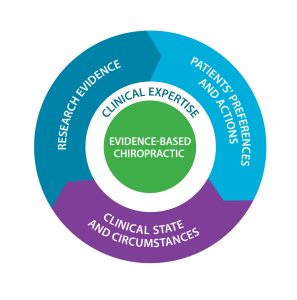
- Adopts the Haynes (2002) model, recognizing the evolution of thought around EBP. This model uses clinical expertise as the lens to integrate the components of patient preferences and actions, clinical state and circumstances, and research evidence.
- Completes engagement with other organizations to obtain feedback on the patient preference paper.
- Develops a paper exploring the evolution and interpretations of the evidence pyramid in reflecting the modern understanding of best available evidence.
- Begins work on the clinical expertise paper.
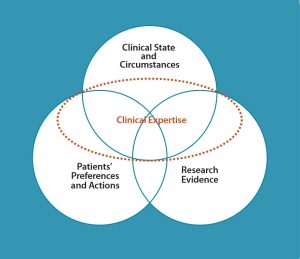
Haynes’ (2002) four-part model, adopted as EBFAC’s preferred model of EBP
- Explores David Sackett et al.’s model (1992) of evidence-based practice (EBP) to guide its work. Known as the “Sackett model”, it defines three pillars of EBP as research evidence, clinical expertise, and patient preferences.
- Reviews three areas of focus of patient preference and expectations and embarks on a deep analysis of the latest research on the best available evidence pillar.
- Investigates the importance of the research question in determining research study design.
- The OCA launches the Evidence-Based Practice Framework strategic project and establishes the advisory council.
- Council holds its first inaugural meeting and subsequent virtual updates.
- Early work focuses on collaborating with partners, influencers, and subject matter experts.
Why this Work Matters and Impact on Chiropractic Care
The OCA EBFAC is building a critical foundation for how a description of chiropractic care that embraces the continuum of care can be developed and communicated. From this foundation, we’ll be partnering with organizations to build practical resources for all chiropractors in Ontario.
Ultimately, we’ll use our comprehensive understanding of chiropractic care to advocate for the profession with government, other health care professionals, and partners to make chiropractic care the trusted first choice for Ontarians, and position chiropractors’ place in Ontario’s broader health ecosystem.
We extend our deepest gratitude to council members for their time, dedication, and commitment to this important work. Your contributions are invaluable to our collective success.
For more information about OCA’s EBFAC work, listen to our ON Spinal Chat podcast episode: An Evidence-based Framework for Chiropractic Care, or read Caroline Brereton ON Care’s blog post entitled: Defining Evidence-based Chiropractic Care to Enhance Patient Outcomes.
If you have any questions, please contact Caroline Brereton at cbrereton@chiropractic.on.ca.